| View previous topic :: View next topic |
Pete Jones
Site Admin
In: Virginia
|
|
 |
|
Tom Van Flandern
Gravitational push, not pull. TVF didn't originate the idea (somebody in the 17th century did, but I think TVF might have taken it the furthest).
The argument is that the idea of push gravity matches the observations better than Newton or Einstein, which TVF goes through in detail in his (jawdropping) Dark Matter, Missing Planets & New Comets.
A detail I remember being impressed by was his reasoning that the speed of light can't possibly be a universal speed limit, because gravity works faster -- in fact, maybe even instantaneously. If it didn't, TVF argues, all orbits would be unstable because gravity would have a speed-of-light lag to it. Havoc!
You also get the most serious discussion that you're likely to find of Cydonia and the "face on Mars" (which is a sphynx, donchaknow)
|
|
 |
|
 |
|
Pete Jones
Site Admin
In: Virginia
|
|
|
|
I left out the most important part: push gravity is mechanical, in the basic sense -- movement of one thing happens only because there is pressure put on it by another thing.
None of Newton's "occult" action at a distance that he had no hypothesis for. No curved space-time. Just basic mechanical action.
|
|
| |
|
|
|
Mick Harper
Site Admin

In: London
|
|
|
|
| Pete Jones wrote: | | If it didn't, TVF argues, all orbits would be unstable because gravity would have a speed-of-light lag to it. Havoc! |
I really really like this one. The whole universe will have to be re-written.
| You also get the most serious discussion that you're likely to find of Cydonia and the "face on Mars" (which is a sphynx, donchaknow) |
I really really didn't like this one. I thought they had taken a photo from a different angle and shown it was a trick of the light.
| None of Newton's "occult" action at a distance that he had no hypothesis for. No curved space-time. Just basic mechanical action. |
The Six-Year-Old's Rule strikes again.
|
|
| |
|
|
|
Pete Jones
Site Admin
In: Virginia
|
|
|
|
| Mick Harper wrote: | | I really really didn't like this one. I thought they had taken a photo from a different angle and shown it was a trick of the light. |
I don't buy any of it, but only because the argument seemed very forced when I read it. Here's the better view:
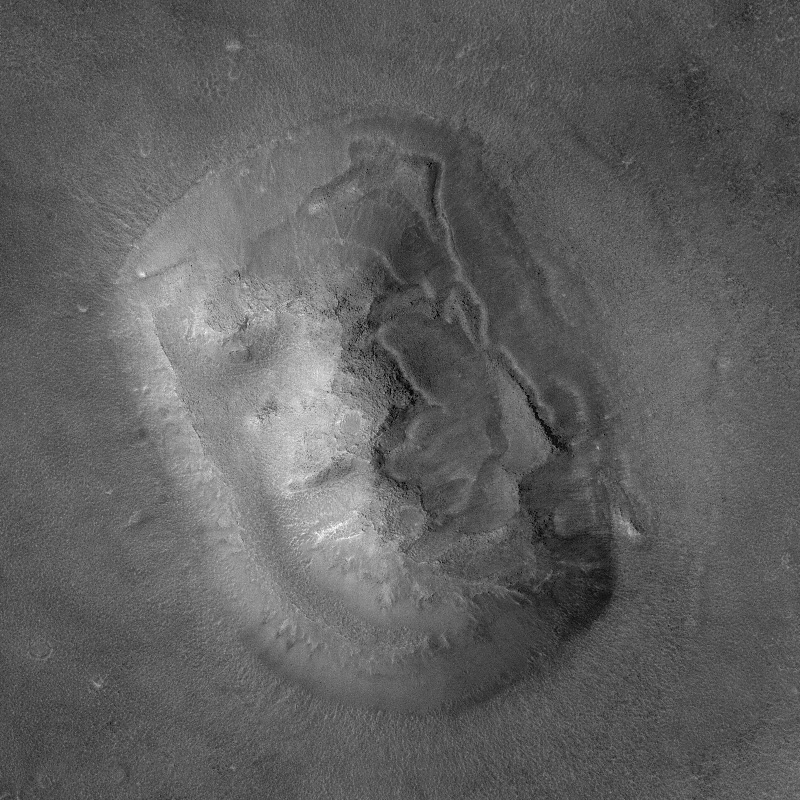
There are those who (of course) make the argument that the higher resolution photos make it more obvious that it's a sphynx (half man-face, half cat-face, rather than the sphynx being man-head and cat-body). There are those who measure the mountain peaks all around it, calculating the angles between them, their polar alignments, etc etc, and say that Egypt and it's pyramids are just a late copycat.
| The Six-Year-Old's Rule strikes again. |
Now one wonders why Newton had to be the winner in the battle for physical explanation. He overthrew basic mechanism, which he knew was a no-no when he was doing it (so I guess he can't be blamed). Something something burgeoning British Empire need for intellectual dominance something something?
|
|
| |
|
|
|
Pete Jones
Site Admin
In: Virginia
|
|
|
|
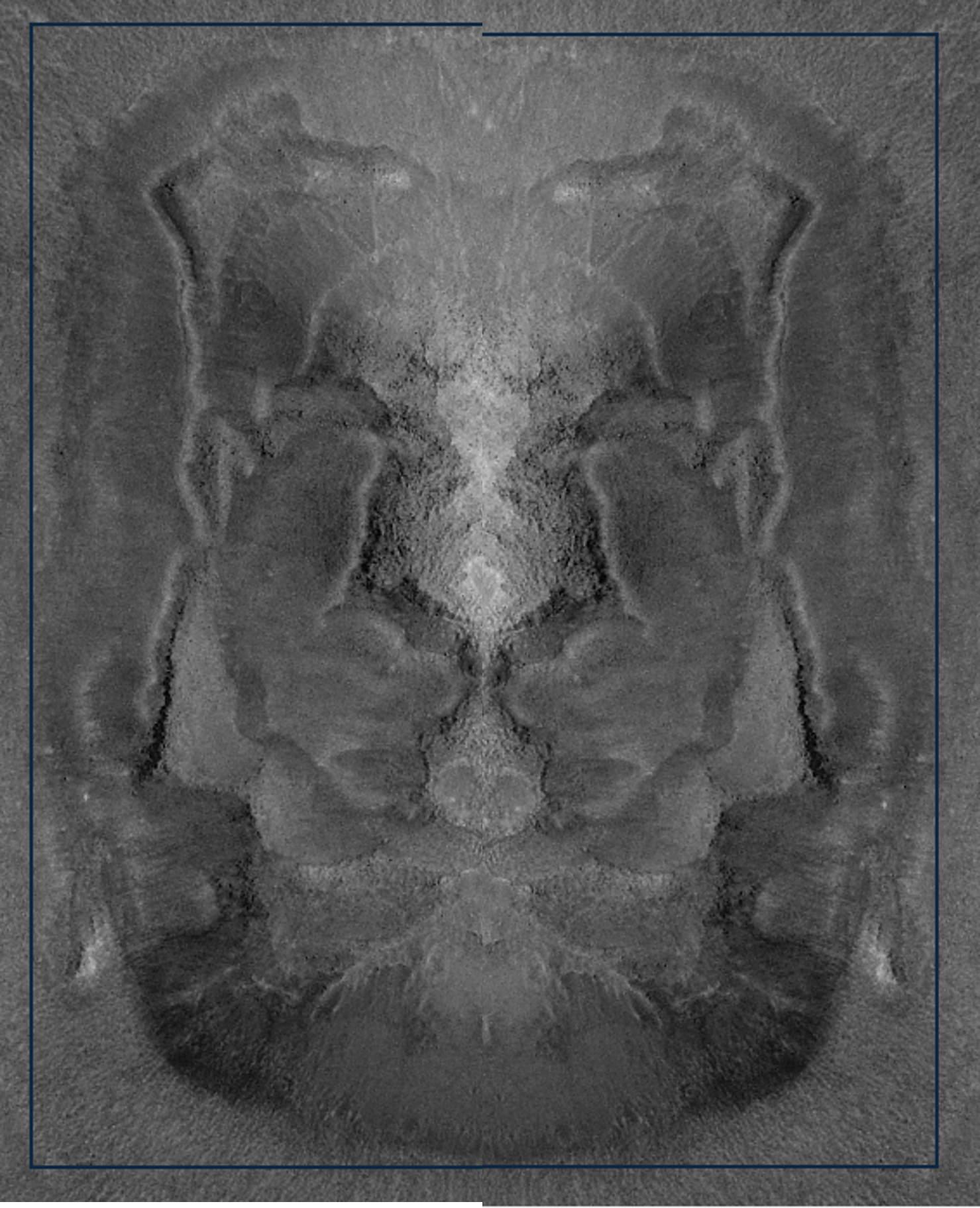
Acourse, here's what you get when you make the cat side symmetrical (geographical symmetry strikes again?!) It's very Skimbleshanks-y
|
|
| |
|
|
|
Pete Jones
Site Admin
In: Virginia
|
|
|
|
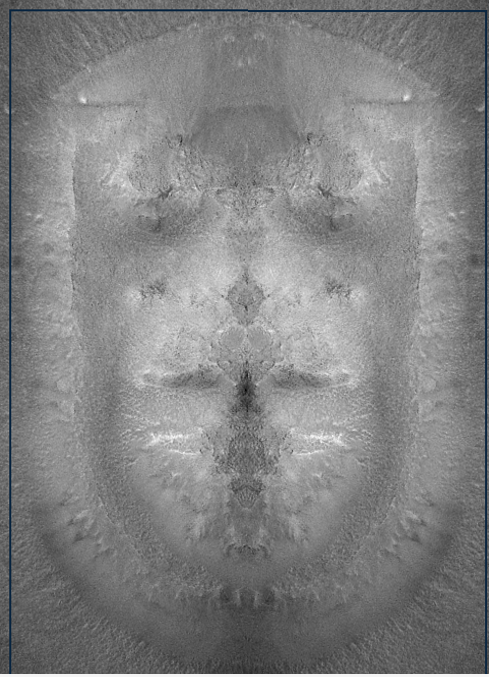
And the other half, mirrored. Simian, I'd say.
|
|
| |
|
|
|
Mick Harper
Site Admin
In: London
|
|
|
|
|
No, I don't know what he's on about either. I thought he was your friend.
|
|
| |
|
|
|
Pete Jones
Site Admin
In: Virginia
|
|
|
|
I know, what's with this guy?
Richard Hoagland
Anyway, it occurred to me that the sphynx argument didn't come from Van Flandern. It came from Richard Hoagland, who is more fruit-forward in his fruitcakery. His book was fun though.
Dark Mission: The Secret History of Nasa does, it's true, show an astronaut planting a Masonic flag on the moon, but I don't recall the freemasonry angle as the most interesting part of the book. That honor goes to the argument that what the Aldrins and Armstrongs saw was the collapse remains of a technological society on the moon.
Their weird interviews and bizarre statements after the fact -- along with all the evidence moon landing hoax believers bring to bear -- are explained by the landing being very real, very unexpected and terrifying. So they had to gin up an alternate version, which they did on a soundstage. But they went, and boy were they not happy afterwards.
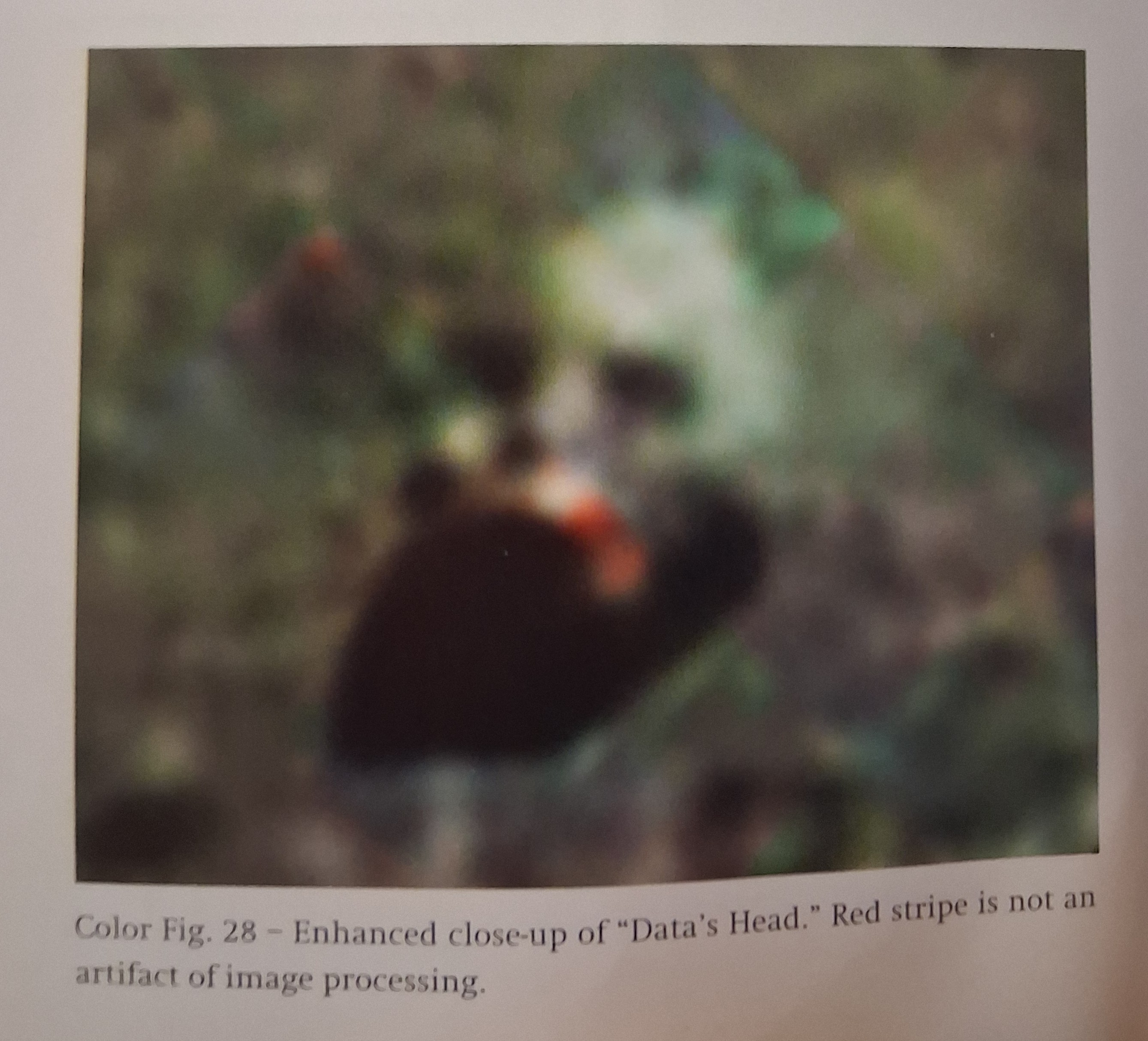
This is one of the more entertaining fruitcake theories out there, and it is a good example of how any sort of evidence can be very convincing when presented well. For instance, did you know ("know") that the black and white photos from the moon had to be made B&W, because they were remarkably full of color in real life? Or so says Hoagland, and so show the photos in his book. I don't know what to think about them. But here's one:
|
|
| |
|
|
|
Mick Harper
Site Admin
In: London
|
|
|
|
|
It is not for me to interfere but this is not a 'fruitcake theory' in the AE sense of being paradigmatic or at any rate of general application. It is a straightforward conspiracy theory.
|
|
| |
|
|
|
Pete Jones
Site Admin
In: Virginia
|
|
|
|
|
You are right. I was trying to clear Van Flandern of being connected to the face/sphynx idea, because there's nothing conspiratorial about TVF. I will leave the Hoagland post up as a constant reminder of my failure.
|
|
| |
|
|
|
Pete Jones
Site Admin
In: Virginia
|
|
|
|
"It seems that when any model becomes an Idol, its advocates begin to act like priests and Inquisitors"
- Robert Anton Wilson, from The New Inquisition: Irrational Rationalism and the Citadel of Science
|
|
| |
|
|
|
Pete Jones
Site Admin
In: Virginia
|
|
|
|
Just finished Ragnarok: The Age of Fire and Gravel, by Ignatius Donnelly. I'm a big fan of Velikovsky, but other than naming the comet as Venus (and then Mars), Donnelly beat V to the punch on the basic picture.
Donnelly ran for Congress (from a much calmer Minnesota) merely so that he could visit the Library of Congress easily, and continue his research. Or so the story goes. If you wanted to be a fruitcake and you didn't have the Internet or Interlibrary Loan, you simply had no choice but to seek and attain political power.
Elements of interest in the book:A discussion of catastrophism in the Book of Job
A discussion of the Great Chicago Fire, which seems clearly to have been an astronomical event, not a bovine event
A few out of place artefacts that appear to me to depict imagery found in petroglyphs
|
|
| |
|
|
|
Boreades

In: finity and beyond
|
|
|
|
Has our Rupert not been mentioned yet?
For those that haven't met him, that's Rupert Sheldrake.
His first claim to fame was Morphic Resonance. While orthodox biologists were busy trying to trash Rupert's ideas on Morphic Resonance, it was the late great David Bohm (quantum physicist) who suggested that Sheldrake's hypothesis was in keeping with his own quantum ideas on implicate and explicate order, and his work on the Holonomic Theory.
https://en.wikipedia.org/wiki/Holonomic_brain_theory
More Rupert here:
https://www.sheldrake.org/
|
|
| |
|
|
|
Boreades
In: finity and beyond
|
|
|
|
I hope that my friends at the Scientific and Medical Network won’t mind me quoting extensively from "Richard Dawkins comes to call". An article by Rupert Sheldrake (published in Network Review, the Journal of the Scientific and Medical Network)
------
Soon before Enemies of Reason was filmed, the production company, IWC Media, told me that Richard Dawkins wanted to visit me to discuss my research on unexplained abilities of people and animals. He believes that science should be based on reason and evidence. So do I. But I also believe it is important to start from people’s experiences, rather than dismissing what they say as superstitious. For example, many dog owners claim that their animals know when a member of the household is coming home; the dogs go and wait at a door or window while the returning person is still miles away. Is this just a matter of routine, or of dogs hearing car engines at a great distance? In controlled experiments in which the animals’ behaviour was filmed continuously, I found that some dogs still seemed to know when their owners were returning at unusual times, in unfamiliar vehicles, and when no one at home knew when they would arrive.
I was reluctant to take part in this programme because I expected that it would be as one-sided as Dawkins’ previous series. But the production team’s representative assured me that they were actually interested in facts, and that “this documentary, at Channel 4’s insistence, will be an entirely more balanced affair than The Root of All Evil was.” She added, “We are very keen for it to be a discussion between two scientists, about scientific modes of enquiry”. So I agreed to meet Richard and we fixed a date.
I was still not sure what to expect. Was he going to be dogmatic, with a mental firewall that blocked out any evidence that went against his beliefs? Or would he be open-minded, and fun to talk to?
The Director asked us to stand facing each other; we were filmed with a hand-held camera. Richard began by saying that he thought we probably agreed about many things, “But what worries me about you is that you are prepared to believe almost anything. Science should be based on the minimum number of beliefs.”
I agreed that we had a lot in common, “But what worries me about you is that you come across as dogmatic, giving people a bad impression of science, and putting them off.”
He then said that in a romantic spirit he himself would like to believe in telepathy, but there just wasn’t any evidence for it. He dismissed all research on the subject out of hand, without going into any details. He compared the lack of acceptance of telepathy by scientists such as himself with the way in which the echo-location system had been discovered in bats, followed by its rapid acceptance within the scientific community in the 1940s. In fact, as I later discovered, Lazzaro Spallanzani had shown in 1793 that bats rely on hearing to find their way around, but sceptical opponents dismissed his experiments as flawed, and helped set back research for over a century. However, Richard recognized that telepathy posed a more radical challenge than echo-location. He said that if it really occurred, it would “turn the laws of physics upside down,” and added, “Extraordinary claims require extraordinary evidence.”
“This depends on what you regard as extraordinary”, I replied. “The majority of the population say they have experienced telepathy, especially in connection with telephone calls. In that sense, telepathy is ordinary. The claim that most people are deluded about their own experience is extraordinary. Where is the extraordinary evidence for that?”
He could not produce any evidence at all, apart from generic arguments about the fallibility of human judgement. He also took it for granted that people want to believe in “the paranormal” because of wishful thinking.
We then agreed that controlled experiments were necessary. I said that this is why I had actually been doing such experiments, including tests to find out if people really could tell who was calling them on the telephone when the caller was selected at random. The results were far above the chance level. The previous week, I had sent Richard copies of some of my papers, published in peer-reviewed scientific journals, so that he could look at some of the data before we met.
At this stage Richard looked uneasy and said, “I don’t want to discuss evidence”. “Why not?” I asked. He replied, “There isn’t time. It’s too complicated. And that’s not what this programme is about.” The camera stopped. The Director, Russell Barnes, confirmed that he too was not interested in evidence. The film he was making was another Dawkins polemic.
I said to Russell, “If you’re treating telepathy as an irrational belief, surely evidence about whether it exists or not is essential for the discussion. If telepathy occurs, it’s not irrational to believe in it. I thought that’s what we were going to talk about. I made it clear from the outset that I wasn’t interested in taking part in another low grade debunking exercise.”
Richard said, “It’s not a low grade debunking exercise; it’s a high grade debunking exercise.”
I said that in that case there had been a serious misunderstanding, because I had been assured that this was to be a balanced scientific discussion about evidence. Russell Barnes asked to see the emails I had received from his assistant. He read them with obvious dismay, and said the assurances she had given me were wrong. The team packed up and left.
© Copyright Network Review, the Journal of the Scientific and Medical Network
|
|
| |
|
|
|
Mick Harper
Site Admin
In: London
|
|
|
|
|
There is a triangular relationship between orthodoxy, anti-orthodoxy and heterodoxy. Not that it is a relationship, no group can lay a glove on either of the other two.
|
|
| |
|
|
|
|
 The Library Index
  FAQ
FAQ  Search
 Register
 Profile
  Log in to check your private messages
  Log in
