| View previous topic :: View next topic |
Mick Harper
Site Admin

In: London
|
|
 |
|
| The many palimpsests associated with early medieval Bobbio, the northern Italian foundation of the Irishman Columbanus (d. 615), plainly reflect a lack of adequate supplies of new parchment but easy access to antiquated manuscripts. |
It looks as though Bobbio was the southern European end of the manuscript racket. Anything on this hive of knaves would be most appreciated. Who'd have thought that one's ability to knock new manuscripts out would depend on how many old ones you happened to have knocking around the place. In a sense that's true! Note the mention of Columbanus. This is way out of his natural orbit so the true connection must be tracked down.
| By contrast, in Anglo-Saxon England 'whose cool damp climate was altogether more favourable for the rich pasture essential for nourishing healthy livestock with good pelts, and which lacked a reserve of old books', palimpsests were extremely rare. |
Astounding news. Leather was more available in Britain than in Italy, the world's most famous leathergoods manufacturer. However we do need to find out why Britain didn't use palimpsests.
|
|
 |
|
 |
|
Mick Harper
Site Admin
In: London
|
|
|
|
Hot news from the Ogham Front. It's an artificial script developed in the eleventh/twelfth centuries by the Norman scriptorium forgers to solve a peculiar problem. There was a requirement to 'salt' various places with bogus tombstones that looked extremely old in order to establish that such-and-such saint/abbot/whatever lived (and died) there.
So why not just age the tombstone artificially, write on the details in 'ancient' lettering and bob's your uncle? Or Abbot Robert of Llandaff was your great-great-twelve times predecessor and therefore had solid title to all the lands around Llandaff and there's a tombstone with his name on to prove it? Well, if you put in the inscription using Welsh, or English or Latin on the bogus tombstones, any local literate would notice and say, "Oi, you just put that there... ". But if it's in Ogham nobody knows what the hell it is until a court case fifty years later, disputing ownership of the land, hears evidence that "An Ogham inscription, we think of the eighth century, clearly shows Abbot Robert ... "
Of course it may be that Normans just pinched the Ogham script and transcribed local names (Irish, Welsh etc) using it but I think this unlikely since who would ever use such a clumsy system rather than alphabets which had been knocking around for at least the previous thousand years? However contrary evidence is requested.
|
|
| |
|
|
|
Mick Harper
Site Admin
In: London
|
|
|
|
| The 12th century Irish Auraicept na n-Éces (the Scholars' Primer), which is the work of several different hands, states in one section that Ogam was invented in Ireland. Yet it also states in another section, (Lines 1105 to 1106), that Gaelic and the Ogam script was invented in 'the plain of Shinar', i.e. Sumer or Mesopotamia, and in another yet again, (line 251), in Auraicept na n-Éces, i.e. 'Accad', or 'Akkad', also in Sumer (Genesis ch.10 v.10.). It is widely acknowledged by scholars that this magnificent work is the principal authority on Ogam script, so why its conflicting claim for a Middle Eastern origin for Ogam should be generally ignored by so many academics is quite beyond this author. |
Here we see, in all its glory, how the forgers are having to 'prove', all of a sudden, the ancientness (not to say authenticity) of Ogham. You can see how they have melded Irishness and Scripturality for maximum effect. The puzzlement of the scholars (then and now) is explained. Though not excused.
|
|
| |
|
|
|
Boreades

In: finity and beyond
|
|
|
|
Sadly, the Ogham Tree Calendar is also most likely to be another fabrication. At best, a pretty but fanciful reinterpretation of wishful thinking by Robert Graves.
The first boot-in comes from Mary Jones:
| Modern pagans are wont to promote a certain "Celtic Tree Calendar" which has thirteen months, named for trees, based upon the ogham alphabet. Some of them assert that the Celts followed this calendar, and that proof of this can be found in the existence of ogham, and in the works of Robert Graves. Unfortunately, this is as false as the assertion that the druids built Stonehenge. |
http://www.maryjones.us/jce/celtictreecalendar.html
Peter Beresford Ellis finishes the job.
On p.117 of The White Goddess Graves actually admits to the following:
'When recently I wrote on this subject to Dr MacAlister, as the best living authority on Oghams, he replied that I must not take O'Flaherty's alphabets seriously: 'they all seem to me to be late artificialities, or rather pedantries of little more importance than the affectations of Sir Pierce Shafton and his kind.' I pass on this caution in all fairness, for my argument depends on O' Flaherty's alphabet... I feel justified in supposing that O'Flaherty was recording a genuine tradition at least as old as the thirteenth century AD.' (My italics are placed in the passage to underline the enormity of what Robert Graves has done.) [Peter Beresford Ellis' emphasis] |
http://cura.free.fr/xv/13ellis2.html
|
|
| |
|
|
|
Hatty
Site Admin

In: Berkshire
|
|
|
|
No need to put the boot in, Graves had long ago distanced himself from it in the preface to his own book... it was just one of the several theories proposed by scholars desperate to explain how an 'alphabet' would appear c 400 and disappear c 600, to be replaced all of a sudden by Latin.
But it shows how academics and their acolytes behave even when not addressing a case of forgery.
It would seem that the Irish are credited with inventing Ogham in dark age prehistory and then... nothing of any significance whatever until the eighteenth century (AD) and Guinness.
|
|
| |
|
|
|
Mick Harper
Site Admin
In: London
|
|
| |
|
|
|
Mick Harper
Site Admin
In: London
|
|
|
|
Making a splash in the world is not hard. Let's take the oldest European book. Here's a picture of it:

To demonstrate it's a forgery would make a splash in the world so read a coupla paras from Wiki and do just that. Don't spoil it for others by saying what it is, just post up "Spotted it!" or something similar. I will reveal the smoking gun for the benefit of duffers in 24 hours.
The St Cuthbert Gospel, also known as the Stonyhurst Gospel or the St Cuthbert Gospel of St John, is an early 8th-century pocket gospel book, written in Latin. Its finely decorated leather binding is the earliest known Western bookbinding to survive, and both the 94 vellum folios and the binding are in outstanding condition for a book of this age. With a page size of only 138 by 92 millimetres (5.4 in × 3.6 in) the St Cuthbert Gospel is one of the smallest surviving Anglo-Saxonmanuscripts. The essentially undecorated text is the Gospel of John in Latin, written in a script that has been regarded as a model of elegant simplicity.
The book takes its name from Saint Cuthbert of Lindisfarne, North East England, in whose tomb it was placed, probably a few years after his death in 687. Although it was long regarded as Cuthbert's personal copy of the Gospel, to which there are early references, and so a relic of the saint, the book is now thought to date from shortly after Cuthbert's death. It was probably a gift from Monkwearmouth-Jarrow Abbey, where it was written, intended to be placed in St Cuthbert's coffin when his remains were placed behind the altar at Lindisfarne in 698, or in the next few decades. It presumably remained in the coffin through its long travels after 875, forced by Viking invasions, ending at Durham Cathedral. The book was found inside the coffin and removed in 1104 when the burial was once again moved within the cathedral. It was kept there with other relics, and important visitors were able to wear the book in a leather bag around their necks. It is thought that after the Dissolution of the Monasteries in England by Henry VIII between 1536 and 1541, the book passed to collectors. It was eventually given to Stonyhurst College, the Jesuit school in Lancashire. | |
|
| |
|
|
|
Mick Harper
Site Admin
In: London
|
|
|
|
You're all far too modest.! Take another look at the pic and then consider this statement
| The book was found inside the coffin and removed in 1104 when the burial was once again moved within the cathedral. |
The book, according to both the Durham monks and modern historians, had spent slightly more than four hundred years in a coffin with a decomposing body. It is not clear to what extent the (oak) coffin was actually underground in Lindisfarne, in Durham and in the several other places it was allegedly shifted to because of Viking raids and other alarums, but it is agreed that the book and the body were constant companions.
Not that the body is decisive. All you have to consider is what four hundred years spent in a wood coffin of Dark Age design will do to a leather-bound book composed of calfskin pages. It would probably disappear altogether but under no circumstances could it look as it does today (the next nine hundred years can be discounted on the grounds that a reliquary can be preserved pretty well). Ironically, the monks themselves are our best witness that it wasn't a reliquary 700 - 1100 AD because the whole point of the exercise was to produce a miraculously preserved personal possession of St Cuthbert. 'Age will not wither them' was a big thing with Medieval Christians.
Now of course Durham monks are entirely justified professionally in pulling a fast one on their congregations but to do that they would have had to actually produce a miraculously preserved St Cuthbert Personal Gospel Book. Which, literally, they did. But modern scholars are not entitled to believe it unless they themselves believe in divine miracles.
|
|
| |
|
|
|
Hatty
Site Admin
In: Berkshire
|
|
|
|
| It presumably remained in the coffin through its long travels |
It's unlikely that even a forensics expert will ascertain from the coffin's interior whether, or how long, the gospel book was there because Cuthbert's body wasn't always in the same coffin... apparently it was first put in a sarcophagus before being transferred to the wooden coffin. They thought of everything.
I'm trying to work out why historians insist, categorically, that the gospel book is 'early eighth century'. It can't be a palaeographic matter because handwriting is notoriously difficult to date and palaeographers themselves say that "dating by palaeography is hazardous at best" and that "uncertainty or downright ignorance are the norm".
Dating vellum hasn't really taken off because...umm... it wasn't permitted. Is it museums who make such decisions?
| Until recently, the relatively large amount of sample needed (ca lOg) has precluded the application of conventional 14C measurement (by standard gas-proportional and liquid scintillation counting methods) to the dating of documents, as it has never been permissible to remove a sufficient quantity of material for worthwhile analysis. |
Now this constraint no longer applies thanks to
| "micro-" and "mini-" methods of 14C measurement by means of accelerators and small counters. |
But vellum/parchment is still difficult to date because, apart from "the random errors inherent in all 14C measurements, and errors of the 14C time scale itself"
| ...long after first use, parchment and vellum were often cleaned to remove the original ink and re-used, such documents being known as palimpsests. |
So 14C dating is seen very much as a last resort, which means you have to turn to the ink used (more often used for invalidating a document than dating it but this only works where twentieth-century ink was used because of the thermo-nuclear emissions).... Except that
| It would be difficult to obtain an adequate sample of the ink itself for 14C dating and to add to this difficulty, ink may sometimes contain dead carbon. |
So having concluded that
| it is unlikely that its age can be resolved satisfactorily by the application of 14C dating, |
it seems you have to rely on palaeography for dating.
|
|
| |
|
|
|
Mick Harper
Site Admin
In: London
|
|
|
|
| It's unlikely that even a forensics expert will ascertain from the coffin's interior whether, or how long, the gospel book was there |
The coffin itself has not survived, surely? Come to think of it, what happened to St Cuthbert's body? This should have been 'miraculously preserved' too when they opened the coffin. Is there any reports re this?
| because Cuthbert's body wasn't always in the same coffin... apparently it was first put in a sarcophagus before being transferred to the wooden coffin. |
As I understand it, the story is that the body and the book were placed 'at the high altar' of Lindisfarne church c 700, this would presumably be in a sarcophagus of sorts even though it is reported as 'a coffin'. Then it was removed because of the Viking raids (first one at Lindisfarne 795 AD) but sarcophaguses being what they are, the body (and presumably the book) was put in a wooden coffin (reported as oak) and whisked around from place to place -- whether above ground or beneath at each stopping place is not disclosed.
But even at Durham itself, the report says the coffin was moved into the cathedral which sounds as though it was buried for some time at Durham. But it doesn't seem to me to make a lot of difference since given wooden carpentry at this time -- or indeed any time -- anything organic in a wooden box is going to get more or less polished off over four centuries.
| They thought of everything |
I assume you mean the twelfth century monks. This is actually the weak link because by doing too much they always, as in all the best CSI dramas, make that one leetle mistake. Remember, the entire body, book, coffin are probably spurious, put together as a package to create a pilgirmage site at Durham in 1107 so any prop knocked down brings the whole lot down.
|
|
| |
|
|
|
Hatty
Site Admin
In: Berkshire
|
|
|
|
The story is that the monks waited eleven years for the body of Cuthbert, who died in 687, to decay but on the day of his sainthood, in 698, upon opening the coffin found his body incorrupt. Having arrived in Durham in 995 with St Cutbert's coffin and of course the Lindisfarne Gospels, the coffin's first home was a wooden or wood + wattle-and-daub church, the White Church, then it was moved in 1104 into the newly built Norman cathedral when the coffin ended up behind the high altar.
The 'Historia Ecclesiae Dunhelmensis', written in the 12th Century by Symeon of Durham, recounts
On the night of 24 August, the nine monks carried the coffin into the new church where the opening took place. They were terrified but proceeded to lift the lid and remove the cloths until the body of Cuthbert was exposed. The monks reported that Cuthbert was lying on his right side, whole and un-decayed, as though he were asleep. The watchers immediately fell on their knees and recited the penitential psalms. Then they took out the bones of Bede and other saints which had been stored in Cuthbert’s coffin and put them to one side.
Two of the monks nervously lifted out the body and the watchers reported that it sagged, as if alive. A new floor was made for the coffin and Cuthbert’s body replaced. News of the revelation spread quickly amongst those who had been invited for the translation ceremony, but scepticism persisted. A further examination was made before independent witnesses and everyone accepted that the body was indeed whole. |
An illuminated manuscript, The Life of St Cuthbert, written in the 1180's, has an illustration of the monks' discovery in 1104.
| Not only was his body incorrupt but his clothes, the text tells us, “seemed to be perfectly new and wondrously brightâ€. Cuthbert is not shown as a monk of his own day but as a late-12th-century bishop, dressed in just the kind of rich vestments that Bishop Puiset himself would have worn. |
In 1104, the 'seventh-century' coffin was placed inside a new coffin which is still on display
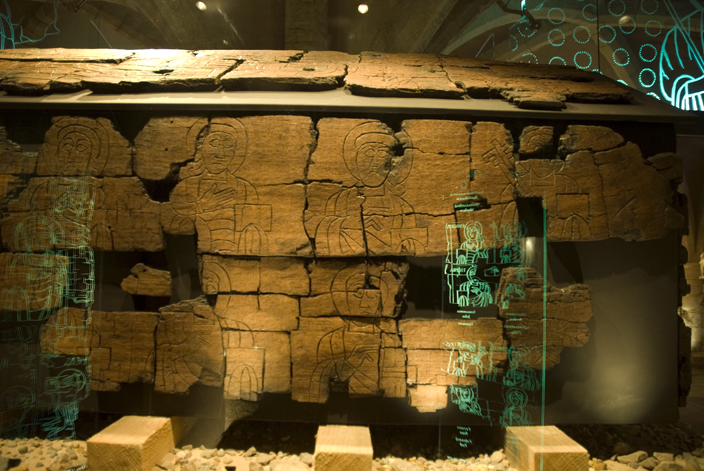
The coffin was opened more than once from the Reformation onwards; in 1899 it was more or less rotten but there was certainly a skeleton... several in fact... though it/they haven't been dated it seems
the coffin revealed a full skeleton with two heads at its feet. As the coffin was being moved it collapsed, spilling a mass of bones and fabric. The bones included: 3 lower jaws, 20 ribs, 35 foot bones, 26 portions of backbone and 7 left shin bones.
| |
|
| |
|
|
|
Mick Harper
Site Admin
In: London
|
|
|
|
As you know I am currently writing a book (a third of a book) showing that the whole history of the British (and Irish) Dark Ages has been made up. A coupla weeks ago, when dealing with Welsh history as per the Lichfield Gospels, I wrote this
But if Welsh was not a written language, how then did it appear in the charters? It is obvious -- the monks invented it. There is nothing novel about churchmen writing down demotic languages (e.g. St Cyril and Cyrillic) but who else would have done it? Only literate people can render a language into writing and the only literate people at this time were churchmen. But the point at issue here is that the monks at Lichfield simply invented Old Welsh by rendering as best they could the Welsh words into Roman letters. Here is an example of what they produced:
[one of the Charters in the Lichfield Gospels book is quoted]
Merely reading it exposes what it actually is: a Latin charter listing all [some of the lands, not all in one charter] the Welsh places that the St Teilo Monastery required to be in its possession. |
I was pleased with this theory (which would, if true, destroy not only large amounts of history but of linguistics too) but last night I read this, from an orthodox commentary on the Book of Armagh, allegedly written in 807 AD
| There follow two more paragraphs concerning Aed, bishop of Sletty, and a certain Conchad. Then a note in Latin, explaining that the writer has used the Irish language because of the number of Irish names included, and the difficulty of making the whole intelligible in Latin. The section ends with four halting hexameters, in which the reader is invited to pray for the scribe. |
On the one hand it was pleasing to find out I was right but of course when I hit the bookstands everyone will say, "Oh, you got that idea from the Book of Armagh."
|
|
| |
|
|
|
Boreades
In: finity and beyond
|
|
|
|
|
For the dim-witted (like me), the major hurdle is believing that writing it down for the first time is the same as making it up. How, from this distance in space and time, can we be sure of the difference?
|
|
| |
|
|
|
Hatty
Site Admin
In: Berkshire
|
|
|
|
The problem is a credibility gap.
The Irish invented Old Irish in the Dark Age, around 800 AD....and nothing else of significance for a thousand years, until Guinness in 1759.
|
|
| |
|
|
|
Mick Harper
Site Admin
In: London
|
|
|
|
| How, from this distance in space and time, can we be sure of the difference? |
Simple. If you make your spoken language a written one you will immediately get a vast literature since everybody will be able to read (or listen to somebody else reading) whatever people want other people to read. That doesn't happen when only Latin (or whatever) is available. If we list the books in Irish (or Welsh) from 800 AD until whenever, the answer is nil (Irish), repetitive and unbelievable Saints' lives (Welsh) and land charters.
Gather round, children, while I read you some land charters.
|
|
| |
|
|
|
|
 The Library Index
  FAQ
FAQ  Search
 Register
 Profile
  Log in to check your private messages
  Log in
