| View previous topic :: View next topic |
Pete Jones
Site Admin
In: Virginia
|
|
 |
|
| Ishmael wrote: | wireloop wrote: | Where is the example of 'p' being used as a symbol for 'phi'? How did you come up with that? |
Here is the actual symbol for phi: ?
Behold the letter p. |
P does look something like ?. It also looks something like Proto-Siniatic/Phoenician Q: ?
Since we're doing "looks like" etymology (my favorite kind), what other connections are there between P and Q?
First, they are mirror images: p and q.
Second, the mainstream says that there are two forms of Celtic: P-Celtic and Q-Celtic.
This gives things like MAP = son in P-Celtic....and MAC = son in Q-Celtic.
I've often worried that the incorrect mainstream chronology has screwed up the cause and effect of documents vs speech. Why Celtic would have two wings that swap P and Q when the SOUNDS are nothing the same, but the LETTERS are nearly identical seems...suspicious.
I would assume there was a misreading of a text somewhere, to account for the change in pronunciation, rather than a morphing of the sound people made.
Based on saying "PUH" and "KWUH" to myself and feeling what my mouth does when forming each sound, I don't see how they could morph into one another.
|
|
 |
|
 |
|
Pete Jones
Site Admin
In: Virginia
|
|
|
|
| Ishmael wrote: | wireloop wrote: | Where is the example of 'p' being used as a symbol for 'phi'? How did you come up with that? |
Here is the actual symbol for phi: ?
Behold the letter p. |
P does look something like ?. It also looks something like Proto-Siniatic/Phoenician Q:
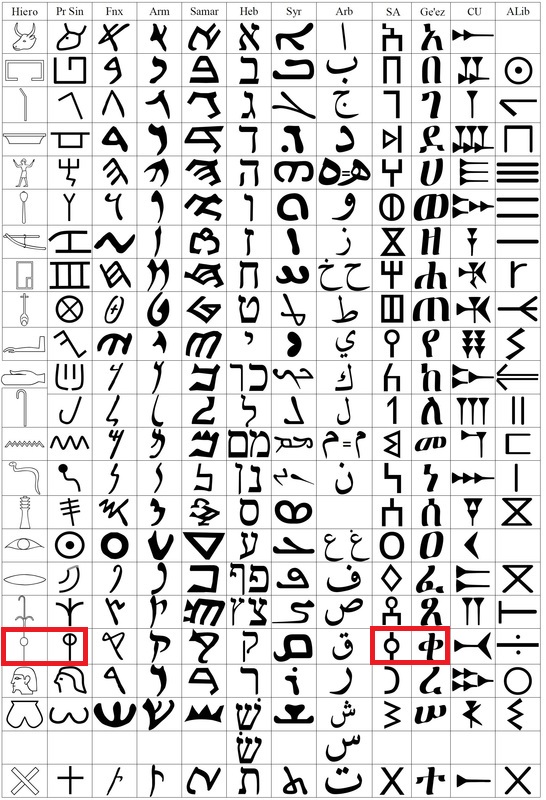
Since we're doing "looks like" etymology (my favorite kind), what other connections are there between P and Q?
First, they are mirror images: p and q.
Second, the mainstream says that there are two forms of Celtic: P-Celtic and Q-Celtic.
This gives things like MAP = son in P-Celtic....and MAC = son in Q-Celtic.
I've often worried that the incorrect mainstream chronology has screwed up the cause and effect of documents vs speech. Why Celtic would have two wings that swap P and Q when the SOUNDS are nothing the same, but the LETTERS are nearly identical seems...suspicious.
I would assume there was a misreading of a text somewhere, to account for the change in pronunciation, rather than a morphing of the sound people made.
Based on saying "PUH" and "KWUH" to myself and feeling what my mouth does when forming each sound, I don't see how they could morph into one another.
|
|
| |
|
|
|
Boreades

In: finity and beyond
|
|
|
|
| Pete Jones wrote: |
This gives things like MAP = son in P-Celtic....and MAC = son in Q-Celtic.
|
Also:
Hebrew : “Ma” = Son of
Gaelic : “Mac” = Son of
|
|
| |
|
|
|
Pete Jones
Site Admin
In: Virginia
|
|
|
|
I think i just realized something. The columns of alphabets i posted above are (i think) supposed to be in chronological order, from left to right.
If so, there is a visual anachronism staring us in the face. Maybe.
|
|
| |
|
|
|
Mick Harper
Site Admin

In: London
|
|
|
|
|
Is that the only example?
|
|
| |
|
|
|
Pete Jones
Site Admin
In: Virginia
|
|
|
|
The most famous example I know of doesn't involve Celtic languages at all, which is highly confusing:
Hippo vs Equus.
But per Wikipedia:
| Gaulish names frequently used 'p', such as EPOredorix (lord of chariot-horses), whereas Q-Celtic would use ECH for horse. |
The Internet provides the following Celtic examples:
Head: Welsh PEN vs Irish CEANN
Four: Welsh PEDWAR vs Irish CETHAIR
Five: Welsh PUMP vs Irish COIG
Thing: Middle Welsh PETH vs Old Irish CUIT
Who: Welsh PWY vs Scottish Gaelic Cò
After/With: Gaulish PETOR vs Irish CETHIR-
|
|
| |
|
|
|
Pete Jones
Site Admin
In: Virginia
|
|
|
|
|
I suppose they would add FOUR vs QUATRO to the list, saying that the F in "four" is the P-Celtic varietal.
|
|
| |
|
|
|
Pete Jones
Site Admin
In: Virginia
|
|
|
|
| Pete Jones wrote: | | If so, there is a visual anachronism staring us in the face. Maybe. |
Why would hieroglyphics, which are highly advanced in how they look, be the oldest?
Wouldn't we expect visual perfection to arise late? Long after the earliest scribblers/scratchers made their rudimentary marks?
|
|
| |
|
|
|
Mick Harper
Site Admin
In: London
|
|
|
|
That would appear to be the case. As far as we know, the Sumerians kicked it off with the most rudimentary system of marks on clay tablets and other Mesopotamians and their neighbours took it on to use more sophisticated but still simple systems, culminating in alphabets. Which have proved adequate for most purposes ever since and thus not improved upon.
The problem has arisen--in my estimation--because (a) Egyptologists and (b) the Chinese are anxious to give their pet method--hieroglyphics--more antiquity than it deserves.
|
|
| |
|
|
|
Wile E. Coyote
In: Arizona
|
|
|
|
| Pete Jones wrote: | The most famous example I know of doesn't involve Celtic languages at all, which is highly confusing:
Hippo vs Equus.
But per Wikipedia:
| Gaulish names frequently used 'p', such as EPOredorix (lord of chariot-horses), whereas Q-Celtic would use ECH for horse. |
The Internet provides the following Celtic examples:
Head: Welsh PEN vs Irish CEANN
Four: Welsh PEDWAR vs Irish CETHAIR
Five: Welsh PUMP vs Irish COIG
Thing: Middle Welsh PETH vs Old Irish CUIT
Who: Welsh PWY vs Scottish Gaelic Cò
After/With: Gaulish PETOR vs Irish CETHIR- |
Four: Welsh PEDWAR vs Irish CETHAIR = After/With: Gaulish PETOR vs Irish CETHIR-
These must be the same...... After = Four
Someone was counting in threes, one two three after....one two three after....
|
|
| |
|
|
|
|
 The Library Index
  FAQ
FAQ  Search
 Register
 Profile
  Log in to check your private messages
  Log in
