| View previous topic :: View next topic |
Mick Harper
Site Admin

In: London
|
|
 |
|
| Wiley wrote: | | This is dimmissed by Ortho as as a failiure. They were do better to remember, Mao. |
While this new bod is with us, could posters endeavour to pay attention to spelling, inadvertent repetitions, syntax, punctuation and grammar lest he gain an unfortunate impression of us. He'll be gone soon enough and we can all relax once more into dyslexic lassitude.
|
|
 |
|
 |
|
Wile E. Coyote
In: Arizona
|
|
|
|
Wiley is moving towards the position that there is very little evidence that I can see for Welsh Kings or so-called Princes pre-Conquest.
According to ortho this is in part because Welsh kings/princes did not put their names on coins. Or, rather, there is a single example of a penny inscribed with the name Hoƿæl Rex.
Now King Hywel was arguably the most powerful ruler of this early fictional Wales (sic), he was otherwise known as Hywel Dda (Hywel the Good). His name is always at the top of the Welsh rulers listed in later chronologies.
At least he has a coin......only it's not actually a Welsh coin, it was minted in neighbouring Chester by a moneyer called Gillys........
Welsh ortho is they didn't need coins. There are very few coin finds within Wales.
I would hazard that Wales=Wills (land).
|
|
| |
|
|
|
Mick Harper
Site Admin
In: London
|
|
|
|
My current position on Welsh history is
Year Dot to 400 AD Unknown
400 AD to 1000 AD Made up
1000 AD to 1400 AD Sparse but genuine
1400 AD to 1700 AD English
1700 AD to 2025 AD OK
|
|
| |
|
|
|
Wile E. Coyote
In: Arizona
|
|
|
|
There is a rather interesting podcast on the history of Rome through 12 coins. https://www.youtube.com/watch?v=vcVaX5Ix16w
It's an orthodox take.
For those AEists that are following, Mick's Purpose of AE you can consider the ORTHO COIN evidence in the first 25 minutes or so. When did Roman coins have Latin inscriptions is what to keep in mind.
Rome's coinage was inspired by the Greeks, so it starts. (this is fundamental to Ortho)
ROME from its first founding 753 BC was trading in unworked and then worked bronze ingots, often referred to as pre-coinage.
Rome develops stamped ingots (Cattle pigs and elephants) around the 5th Century, not much use for the common people, according to the podcast.
"Rome is late to the coinage party", (so perhaps not inspired by Greek coinage as first thought) as coinage in use in the Greek city states including colonies in boot of Italy for a couple of hundred years before Rome gets the hang of it (?), that is despite its functionality for exchange and as a tool of propaganda, and as a payment for soldiers.
It's about third century BC before Rome is finally inspired by the Greek coinage, and (they finally add in the coinage of Carthage), eg you have "Of Rome" stamped in a Greek inscription, not Latin inscription, on a coin from Neopolis (Naples) ...(eh?) This is seen as Rome trying to emulate Greeks.
But mysteriously Rome still keeps its bronze coinage until Second Punic war. They then invent the Denarius along with stamped Latin legends which becomes the Roman currency for the next 400 Years or so.....
It's a remakably slow journey (having been so inspired by the Greeks) they conclude.
They see the problem.
But it's precoinage.....must have happened like that to fit in with the history.
|
|
| |
|
|
|
Wile E. Coyote
In: Arizona
|
|
|
|
You are now an expert in Roman Precoinage, which you can securely date to somewhere between 700-BC and no later than the Second Punic War.
You just need to sound authoritative.
You are well placed to discuss the Denarius after a short digression on Hannibal.
|
|
| |
|
|
|
Mick Harper
Site Admin
In: London
|
|
|
|
| Wiley wrote: | | It's about third century BC before Rome is finally inspired by the Greek coinage, and (they finally add in the coinage of Carthage), eg you have "Of Rome" stamped in a Greek inscription, not Latin inscription, on a coin from Neopolis (Naples) ...(eh?) This is seen as Rome trying to emulate Greeks. |
Surely this is clear proof that the Romans did not have Latin before, say, 200 BC. (I am assuming that, despite reference to 'a Greek inscription', this is genuine.)
PS That means Neopolis wasn't called Neopolis at the time (or at any rate wasn't spelled using those letters).
|
|
| |
|
|
|
Wile E. Coyote
In: Arizona
|
|
|
|
The podcast is a bit skippy on the pre-coinage bit, it is used as an intro to the main Roman coins.
As Wiley understands Ortho.
Ortho position is that Neapolis was originally a Greek colony, and the use of Greek script continued on its coins even when they became part of or allied to the Roman Empire. This could be because the Romans were controlling the minting process.
So you get a Greek inscription (e.g., "of the Romans" - ΡΩΜΑΙΩN) on an otherwise Greek style Neapolis coin.
|
|
| |
|
|
|
Mick Harper
Site Admin
In: London
|
|
|
|
Wiley, I received this today from a correspondent:
I don't see what qualifies it as a coin and I was intrigued to know what a 'certified metal detectorist' is when he's at home. But I promised to hold fire until I ran it past our certified coin expert.
|
|
| |
|
|
|
Wile E. Coyote
In: Arizona
|
|
|
|
Some countries have trusted certified detectorists (not for profit) rather than private ones.
I am a bit confused as, if a coin, it appears mint condition, ie without wear and tear, therefore never in circulation.
Anything with a torc on it normally gets classified as "Celtic" but it was found, so they say, in an area not settled by Celts.
It don't look like an abstract stag to me.
It looks like a top view of Obelix to Wiley.
|
|
| |
|
|
|
Mick Harper
Site Admin
In: London
|
|
|
|
As you know, AE operates a rule of thumb about ye olde coins
| A hoard is presumed genuine, individual coins may or may not be. |
This is obvious enough and arises from the fact that a large number of coins all found at once presents too many difficulties (and depresses the value) for forgers. These coins are certainly genuine:
Being late twelfth century they are not particularly significant for our purposes but they are worth mentioning because this shows the kind of thing that would be expected when coins are a routine part of the local economy.
When you are faced with many centuries when such hoards are notably absent, you are entitled to draw conclusions.
|
|
| |
|
|
|
Pete Jones
Site Admin
In: Virginia
|
|
|
|
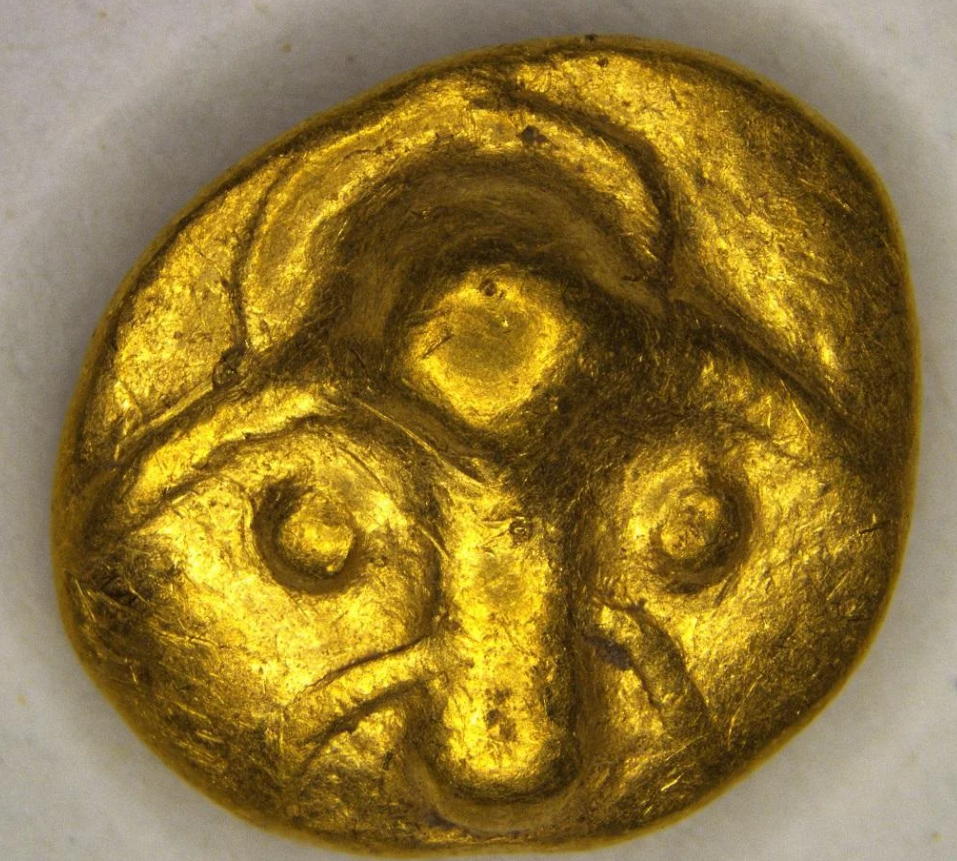
| Wile E. Coyote wrote: | It don't look like an abstract stag to me.
It looks like a top view of Obelix to Wiley. |
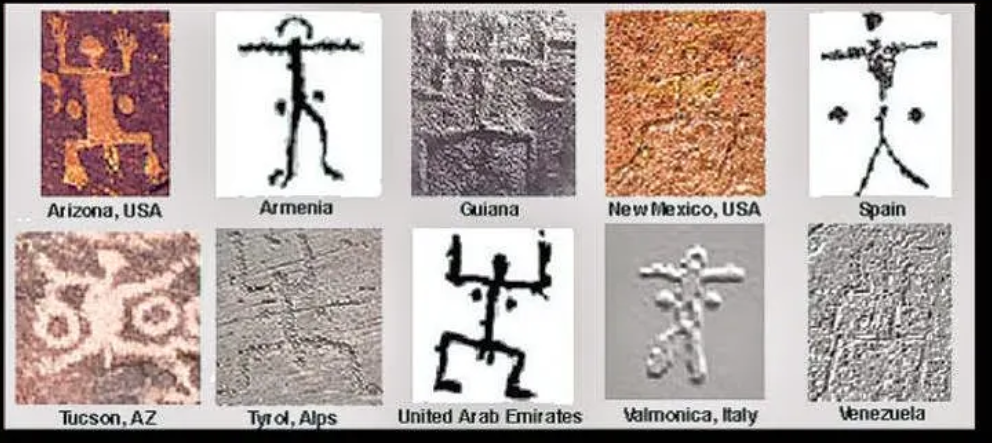
It looks like the "Squatterman" petroglyph, to me. Some elements of Tucson, Arizona (get over there Wiley) and Armenia:
|
|
| |
|
|
|
Pete Jones
Site Admin
In: Virginia
|
|
|
|
A funny linguistic thing, re: the TORC. It is said to come from a Latin original, meaning "twist", and giving us also English's TORQUE. Fine, okay, maybe!
But a much more on-the-nose source might be Arabic's á¹awq. It only means, you know, "anything that surrounds another thing, ring-shaped border, hoop, headband, necklace etc." Just the exact thing a TORC is.
The Arabic is said to be cognate with Proto-Semitic's *kabkab-, which means star.
Now, the other side of the coin, with "torc, sphere, and star" looks a bit odder. Are torcs themselves related to stars, planets, and, apparently, petroglyphs?
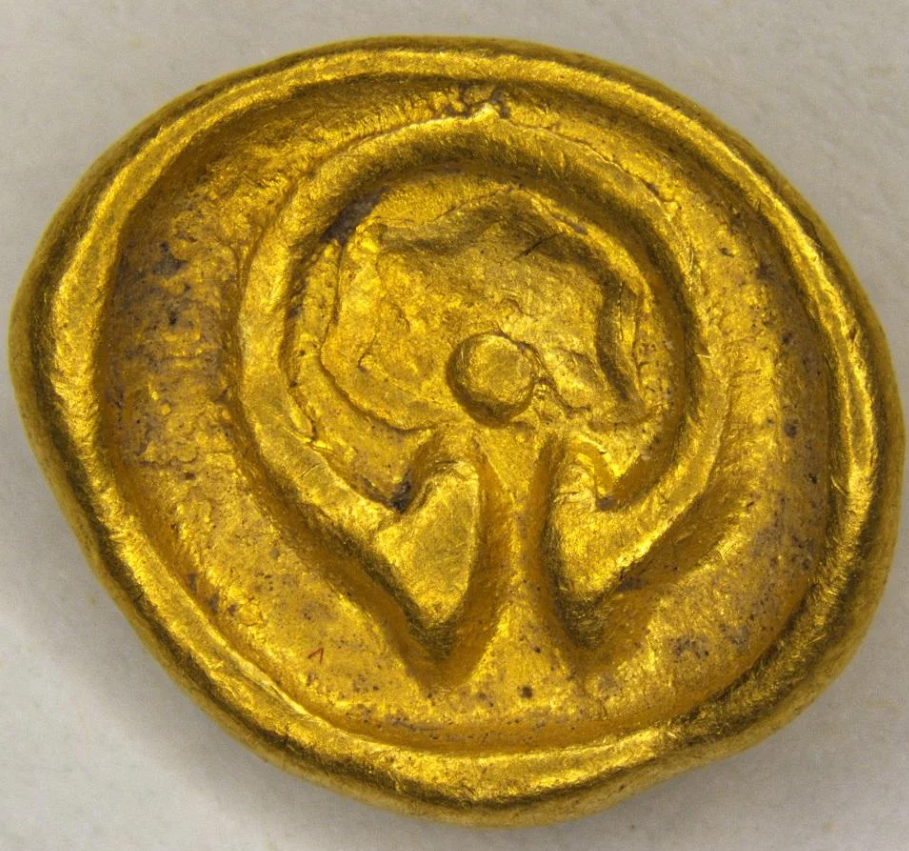
If I were going full-Electric Universe, I'd say this looks like one of the planetary gods in the midst of a plasma haze, surrounded by the torc (a representation of the "enclosing" plasma sheath itself)
|
|
| |
|
|
|
Pete Jones
Site Admin
In: Virginia
|
|
|
|
|
Both sides of this coin match a theory I think is true (note that squatterman is also an Electric Universe motif), so I deem this coin either authentically old or a very curious and clever fake.
|
|
| |
|
|
|
Mick Harper
Site Admin
In: London
|
|
|
|
|
What would the faker have to know to keep on message?
|
|
| |
|
|
|
Pete Jones
Site Admin
In: Virginia
|
|
|
|
|
See "Around the World" thread in "Pre-History" section for my answers...
|
|
| |
|
|
|
|
 The Library Index
  FAQ
FAQ  Search
 Register
 Profile
  Log in to check your private messages
  Log in
