| View previous topic :: View next topic |
Boreades

In: finity and beyond
|
|
 |
|
Theuth (or Thoth) promises that writing will make people wise.
The king, Thamus, shakes his head
| And so it is that you by reason of your tender regard for the writing that is your offspring have declared the very opposite of its true effect. If men learn this, it will implant forgetfulness in their souls. They will cease to exercise memory because they rely on that which is written, calling things to remembrance no longer from within themselves, but by means of external marks. |
| What you have discovered is a recipe not for memory, but for reminder. And it is no true wisdom that you offer your disciples, but only the semblance of wisdom, for by telling them of many things without teaching them you will make them seem to know much while for the most part they know nothing. And as men filled not with wisdom but with the conceit of wisdom they will be a burden to their fellows. | |
|
 |
|
 |
|
Pete Jones
Site Admin
In: Virginia
|
|
|
|
A few years ago, I read (and was piqued by) a Fomenko-ite book showing that Plato and Plethon (the big Neo-Platonist) were the same person and that the works of Plato were written in the 1400s or so and just backdated to 400BC.*
The question of course is a chicken and the egg. Were the Neo-Platonists interested in Platonism because they read it and got excited? Or were they the original Platonists who wrote and then lied about where they got it?
I see the same problem in the Panini algorithm for Sanskrit grammar. Did the Indologists figure out the "Sanskrit Code" and then write it up, forge some texts in 1875, and then claim it was memorized for 2500 years? Probably not, but if we find forgers involved in the story, I'll be suspicious.
Oh, and apropos of nothing, I'll post up about George Buhler tomorrow.
______________
* author was Tristan Sylvain, and I believe Mick said that he and Hatty met him once at a Megalithia conference....Mick? Hatty?
|
|
| |
|
|
|
Mick Harper
Site Admin

In: London
|
|
|
|
|
Hatty will correct me but my memory is to the effect that Tristan Sylvain was a chief speaker (the chief speaker?) at the annual Mythomania Conference where I delivered my Megalithic Seafaring lecture. We were both mildly shocked by the paucity of his effort. (And the great acclaim accorded to it by the Mythomania audience.)
|
|
| |
|
|
|
Pete Jones
Site Admin
In: Virginia
|
|
|
|
The Second of the Three Sages of Sanskrit Grammar is Katayayana.
The first thing to notice is that the Indologists who maintain Wikipedia outright state that Katyayana might be a pure legend. He is from the time after Aristotle, yet no Greek scholar says Aristotle is a legend. But here on Wikipedia, the Sanskrit Sages are not treated as definitely-real people.
Wiki (emphasis added):
| Katyayana is maybe another name of Vararuci, a re-incarnation of Lord Shiva's gana or follower Pushpadanta. The story also mentions him learning grammar from Shiva's son Kartikeya, who teaches Katyayana the rules of grammar in a way that it could be UNDERSTOOD EVEN BY CHILDREN. It may be that his full name was in fact Vararuci K?ty?yana. |
Kartikeya is the God that corresponds to Mars, by the way.
Katyayana wrote this:
The Varttikakara, an elaboration on Panini grammar.
Along with the Mahabhasya of Patanjali, this text became a core part of the Vyakara?a (grammar) canon.
This was one of the six Vedangas, and constituted compulsory education for students in the following twelve centuries. |
Twelve centuries of textbooks! Finally. But no, there are no textbooks. It was all memorized until a late manuscript copy was discovered. Typical.
But no! The story is even worse. A German scholar EXTRACTED the works of the Second Sage Katyayana FROM the prose of Third Sage, Patanjali.
Essentially, a 19th century German looked at Patanjali and inferred Katyayana:
| Patanjali quoted and discussed Katyayana’s Varttikas so thoroughly that modern scholars have been able to reconstruct the original text of the Varttikas almost entirely from Patanjali's commentary. |
Who was this modern scholar? Franz Kielhorn. He got ahold of the double book of Patanjali and, using his brain, determined that Katyayana's work was inside it.
Panini is known through Patanjali.
Katyayana is inferred from Patanjali.
The works of Patanjali were discovered in a copy made around 1875.
All are admitted to be semi-legendary, even by the mainstream.
Here's the key disconnect that I see: Kielhorn sounds like more of a genius than any Sanskrit scholar, ever. And there were Sanskrit scholars for 1200 years who had been memorizing ALL these works and they never once DISCOVERED Katyayana within the works of Patanjali!? The poor dunces. 1875 was truly a proud day for Europeans everywhere, I guess.
|
|
| |
|
|
|
Mick Harper
Site Admin
In: London
|
|
|
|
But it must be old, Hindi is derived from it and Hindi has gotta be helluva old if hundreds of millions of people are busy chatting away in it. Plus all the intermediate languages.
| AI wrote: | Hindi is primarily derived from Sanskrit. It evolved from ancient Indo-Aryan languages through intermediate stages:
Vedic Sanskrit
Shauraseni Prakrit
Shauraseni Apabhramsha
Old Hindi (Khariboli)
Modern Hindi (Khariboli)
Modern Hindi became standardized in the 19th/20th century with significant Persian, Arabic, and English influences |
That's the 'primarily' bit presumably. You will notice that both Old and Modern Hindi are called Khariboli. FYI, the plural of Khariboli is Kharibolix.
|
|
| |
|
|
|
Pete Jones
Site Admin
In: Virginia
|
|
|
|
| Mick Harper wrote: | | But it must be old...FYI, the plural of Khariboli is Kharibolix. |
Seems like it must be at least old. Ish. Maybe.
Let's return to "Skambha," where this all started. This is what AI gave me when it offered to track any word I chose though the history of the Sanskrit-to-Hindi evolution:
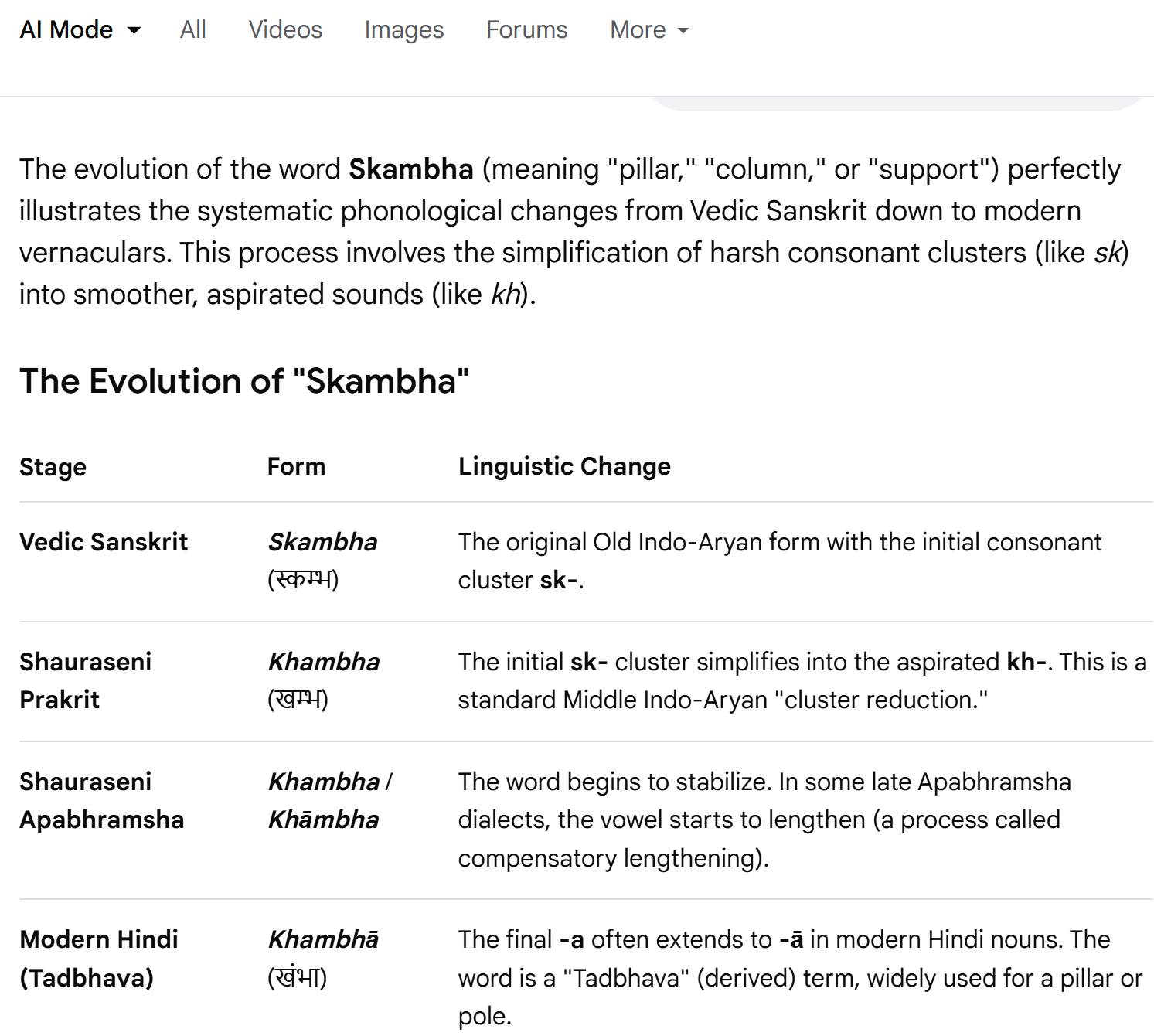
An S drops off the front, and the sound of the final vowel sliiiightly changes....but not until modern Hindi (i.e., at the very last minute). And for AI, this is a "perfect illustration" of systematic phonological changes....over almost 3,000 years.
But it left something out. Namely, "Skambha" became "Stambha." Here's the proof:
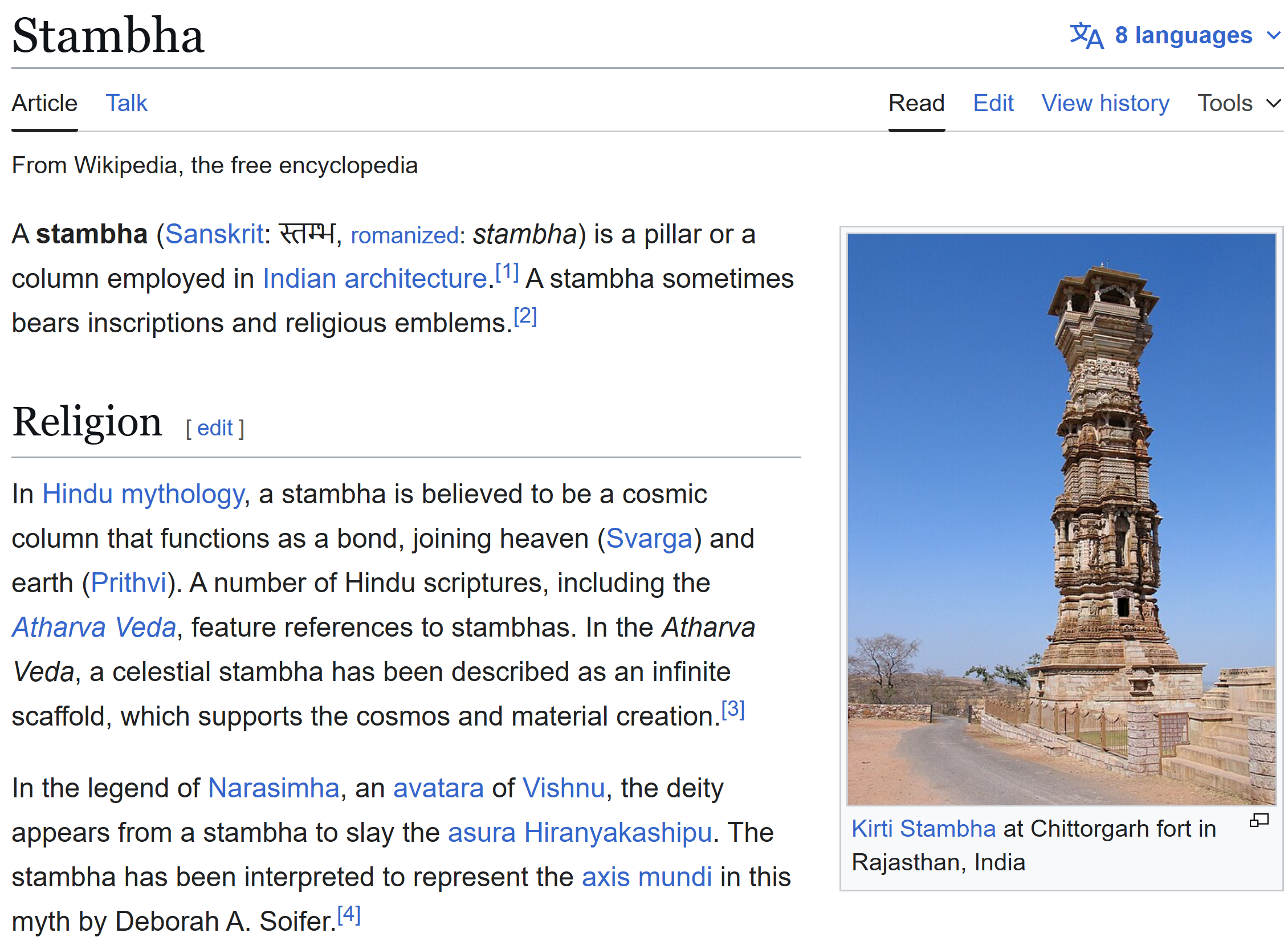
When did this change happen?
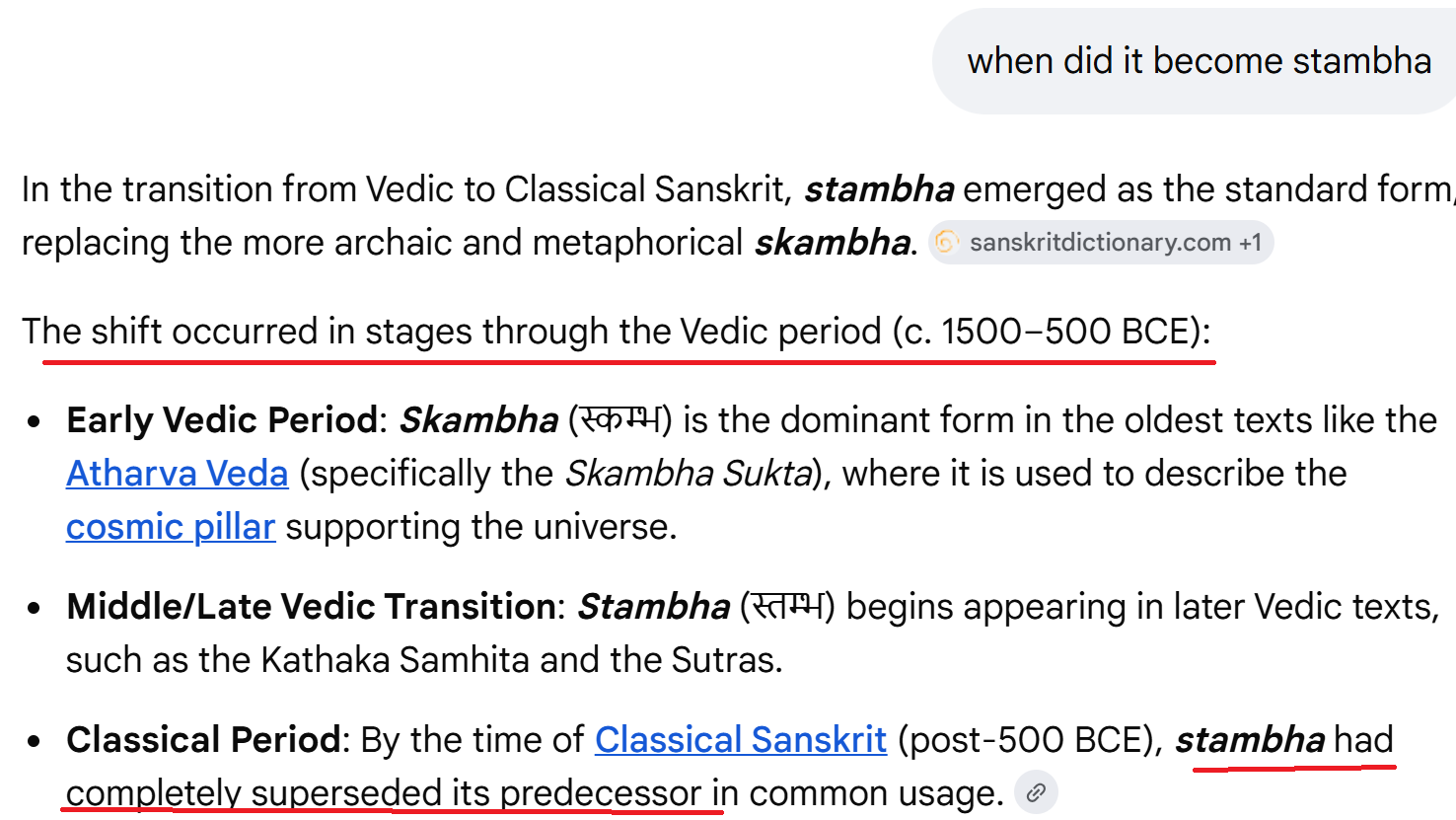
"Completely superseded"? Bolix. Skambha survives as both Khamba and Stambha in Hindi.
|
|
| |
|
|
|
Pete Jones
Site Admin
In: Virginia
|
|
|
|
This is why I find Sanskrit history extremely confusing.
Another closely word for Stambha and Skambha is "Stabdha." The -dha is apparently just a suffix, but why are both the K and the M removable?
The AI explanation doesn't appear to make sense:
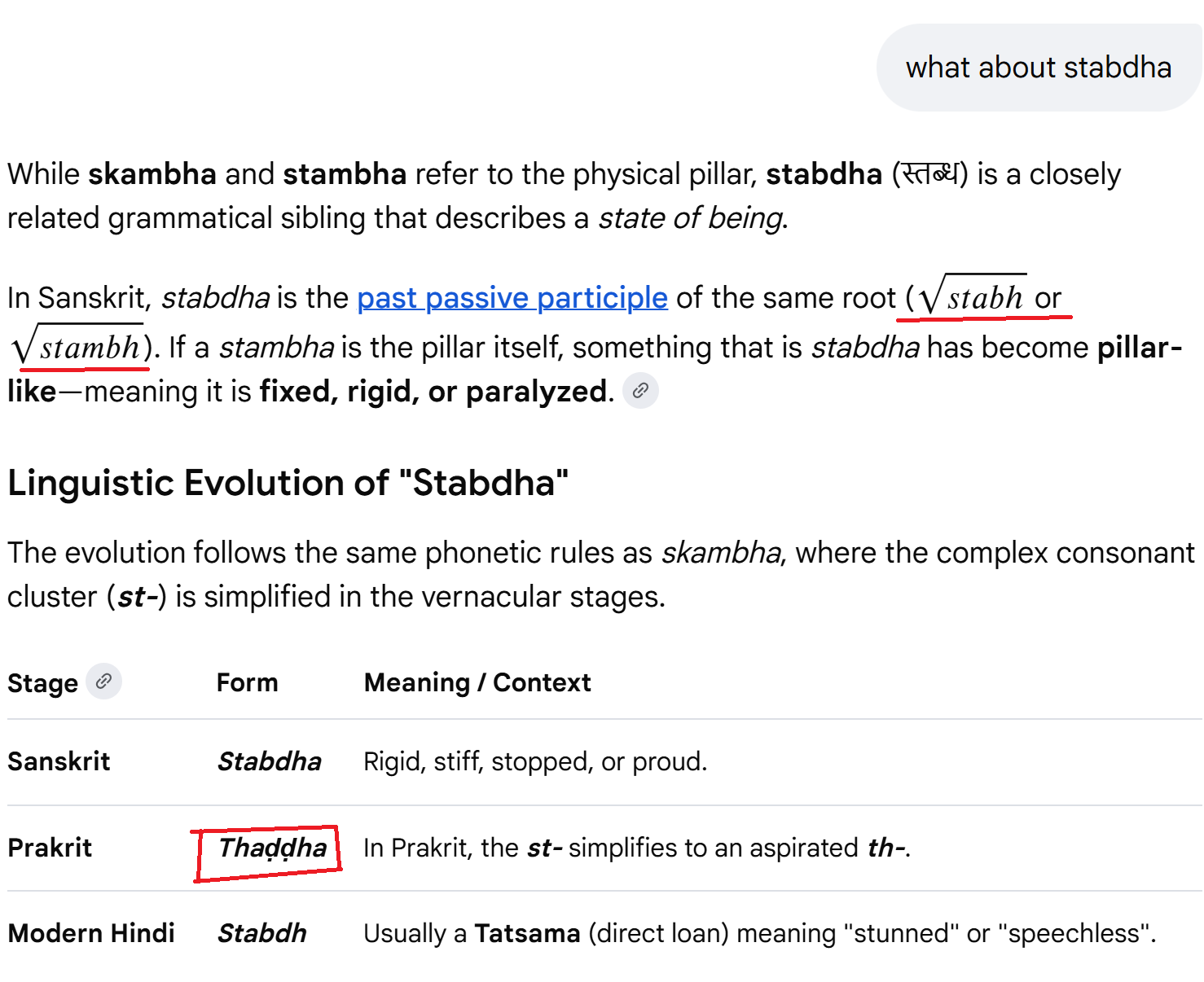
Why did the Prakit drop BOTH the S and the B sound, only for both to reappear in Modern Hindi?
That is, why would the modern tongue reach back into the deep past for a pronunciation when the Vulgar Prakits had stripped and slurred the word down to essentially "Dada"?
It seems like a conscious resurrection of an "archaic" form, like when the State of Israel resurrected Hebrew.
With the Skambha>Stambha change being no actual change at all (both words are still used) AND the resurrection of an ancient pronunciation AND the assertion that the root word has TWO separate pronunciations, I am suspicious.
Mispronouncing Skambha is really like an English-speaking Christian mispronouncing "Cross." These are the literal central pillars of the axis mundi myth for each culture.
|
|
| |
|
|
|
Pete Jones
Site Admin
In: Virginia
|
|
|
|
Georg Buhler. Very important German Indologists in the 19th century.
Very, very important:
- He discovered over 5,000 manuscripts, many of which were previously unknown to the Western world.
These collections formed the basis for many critical editions of Sanskrit texts used by scholars globally today. |
He's the source of the texts that are used today. Got it. In fact, Max Muller (a great name himself) said this in his eulogy:
| He who for so many years was the very life of Sanskrit scholarship, who helped us, guided us, corrected us in our different researches, is gone. |
He was the Pope of Sanskrit Town, you might say elegantly.
- He specialized in deciphering ancient inscriptions on stone and copper plates, which provided a historical timeline for ancient India that Sanskrit literature alone could not offer.
- His 1896 work, Indische Palaeographie (Indian Paleography), remained the definitive authority on the development of Indian scripts for decades. |
He's the source for deciding when a text was written. Based on analysis of script styles.
What else do we know? He died in mysterious circumstances, drowning in a lake. Somebody spotted a rower one day, then the boat came back empty, then no body turned up. Weighted down? Apparently. Turned out later it was Buhler.
Maybe it was an accident, because why would this grand old man of Sanskrit kill himself?
Why would he kill himself, specifically, on March 8, 1898?
|
|
| |
|
|
|
Boreades
In: finity and beyond
|
|
|
|
| Pete Jones wrote: | | Why would he kill himself, specifically, on March 8, 1898? |
I doubt it was because he'd missed the premiere of Richard Straus' "Don Quixote", on that day in Keulen.
Please do tell.
|
|
| |
|
|
|
Pete Jones
Site Admin
In: Virginia
|
|
|
|
I don't mind if I do.
A month before the boat accident, March 1898, one of his closest collaborators, Alois Anton Führer, then 45 years old, was "dismissed from government service for forging Buddha relics."
Actually, Fuhrer was giving "fuhrer" a bad name for years. Wikipedia provides his biography and, starting in 1891, every subsection of the Wiki page is about a different forgery episode or other scandal. These included invented inscriptions, plagiarism (of Buhler, funny enough), and forged relics. Presumably these were all uncovered (realized?) after the 1898 firing.
Back to Buhler. He and Fuhrer weren't just likeminded Germans scouring India at the same time for manuscripts, they were:
Mentor and Patron:
Bühler, a respected professor in Vienna, supported Führer’s career, recruiting him for academic projects such as editing a Dharmasastra for the Bombay Sanskrit Series.
They maintained a close professional relationship, described by some as a "partnership" where Führer acted as a field agent/acquisitions expert in India, and Bühler provided academic backing and academic exposure for the findings in Europe. |
How ridiculously cool was Fuhrer at the time?
These discoveries [of relics of the Buddha himself], at the time they were made, generated fantastic praise for the work of Führer.
According to the New York Post (3 May 1896) the Nigliva discovery "seems to carry the origin of Buddhism much further back".
The Liverpool Mercury (29 December 1896) reports that the discovery that Lumbini (also called Paderia) was "the actual birthplace of the Buddha ought to bring devout joy to about 627,000,000 people".
The Pall Mall Gazette (18 April 1898) related that the Piprahwa discovery "contains no less a relic than the bones of the Buddha himself". | |
|
| |
|
|
|
Pete Jones
Site Admin
In: Virginia
|
|
|
|
The Pall Mall Gazette date is curious. Its 12 days after Fuhrer came under investigation. His papers weren't seized until September of 1898.
So the question is, why did Buhler do himself in? He certinaly didn't wait for the results of the inquiry, which couldn't really begin until they had all the evidence. Was the guilt by association and reflected shame so daunting that he couldn't go on? Or did he know the jig was up? Or did his (probably) severe case of Prussianism cause him to take the honorable way out?
Remember, Buhler is the Father of Sanskrit Studies and Fuhrer is his handpicked man-in-the-field out there acquiring artefacts. Buhler himself discovered 5,000 manuscripts. These guys were digging and finding gold.
But really the question is, why was I able to find a forger in the hip pocket of the man who created the field?
This isn't all, but I'll save it.
|
|
| |
|
|
|
Pete Jones
Site Admin
In: Virginia
|
|
|
|
|
(Can someone tell me if they can still see the images from a few posts ago, the ones about Sanskrit's "Skambha"? They arent showing up for me)
|
|
| |
|
|
|
Boreades
In: finity and beyond
|
|
|
|
| Pete Jones wrote: | | (Can someone tell me if they can still see the images from a few posts ago, the ones about Sanskrit's "Skambha"? They arent showing up for me) |
I can see an image with a white background and :
What about stabda
While skambha and stambha refer to the physical pillar, stabdha (...) is a closely related grammatical sibling that describes a state of being. | |
|
| |
|
|
|
Mick Harper
Site Admin
In: London
|
|
|
|
I can see everything so far as I can tell. Pete: try again on a computer or a different computer or something. Make a record of what you have posted up and we'll go through it on Zoom.
Could anyone else that's having difficulty with this sort of thing, sing out?
|
|
| |
|
|
|
Mick Harper
Site Admin
In: London
|
|
|
|
| Pete Jones wrote: | | Georg Buhler. Very important German Indologists in the 19th century. Very, very important: - He discovered over 5,000 manuscripts, many of which were previously unknown to the Western world. |
The number indicates these are genuine manuscripts in the sense he didn't concoct them himself (cf hoards of coins vs single finds).
| These collections formed the basis for many critical editions of Sanskrit texts used by scholars globally today. |
This is standard second-generation scholarship. Don't do any hard graft yourself just allow yourself to be carried on the shoulders of giants.
| He's the source of the texts that are used today. Got it. In fact, Max Muller (a great name himself) said this in his eulogy: |
Are you referring to Max Miller, Britain's most famous music hall comic?
| He who for so many years was the very life of Sanskrit scholarship, who helped us, guided us, corrected us in our different researches, is gone. |
'We shall never see his like again. First of all, there's no need. Second of all, if somebody else like him did come along we might find we'll have to... um... correct the first dude's researches.'
| He was the Pope of Sanskrit Town, you might say elegantly. |
Sung by the Two-Tones. Impressive.
| - He specialized in deciphering ancient inscriptions on stone and copper plates, which provided a historical timeline for ancient India that Sanskrit literature alone could not offer. |
Stone and copper plate is not datable scientifically, manuscripts are. (Though he wouldn't have known this at the time.)
| His 1896 work, Indische Palaeographie (Indian Paleography), remained the definitive authority on the development of Indian scripts for decades. |
You imply it no longer is. Is that the case?
| He's the source for deciding when a text was written. Based on analysis of script styles. |
Script styles is not worth the paper it's written on when it comes to scientific dating.
| What else do we know? He died in mysterious circumstances, drowning in a lake. Somebody spotted a rower one day, then the boat came back empty, then no body turned up. Weighted down? Apparently. Turned out later it was Buhler. |
So not Fredo Corleone then?
| Maybe it was an accident, because why would this grand old man of Sanskrit kill himself? Why would he kill himself, specifically, on March 8, 1898? |
I'm with Borry. Do tell.
| A month before the boat accident, March 1898, one of his closest collaborators, Alois Anton Führer, then 45 years old, was "dismissed from government service for forging Buddha relics." |
Good but not gaudy.
| Actually, Fuhrer was giving "fuhrer" a bad name for years. Wikipedia provides his biography and, starting in 1891, every subsection of the Wiki page is about a different forgery episode or other scandal. These included invented inscriptions, plagiarism (of Buhler, funny enough), and forged relics. Presumably these were all uncovered (realized?) after the 1898 firing. |
There's a bogus list entry in there: 'of Buhler, funny enough'. Presumably is not good enough for these purposes.
| Back to Buhler. He and Fuhrer weren't just likeminded Germans scouring India at the same time for manuscripts, they were: Mentor and Patron: Bühler, a respected professor in Vienna, supported Führer’s career, recruiting him for academic projects such as editing a Dharmasastra for the Bombay Sanskrit Series. |
The normal pattern is for the mountebank to approach the academic with an offer he can't refuse. Whereupon the relationship gets reversed as the Godfather tells the gumbah what's what. Later, the latter rats out the former.
| They maintained a close professional relationship, described by some as a "partnership" where Führer acted as a field agent/acquisitions expert in India, and Bühler provided academic backing and academic exposure for the findings in Europe. |
Yep, that's always the way.
| How ridiculously cool was Fuhrer at the time? These discoveries [of relics of the Buddha himself], at the time they were made, generated fantastic praise for the work of Führer. |
Are we talking strictly peer review here? I would have thought large sums of money would be involved somewhere along the line.
| According to the New York Post (3 May 1896) the Nigliva discovery "seems to carry the origin of Buddhism much further back". The Liverpool Mercury (29 December 1896) reports that the discovery that Lumbini (also called Paderia) was "the actual birthplace of the Buddha ought to bring devout joy to about 627,000,000 people". |
That elevates the whole thing to Raj level. 'Do we want Germans in charge of this, Carruthers?'
| The Pall Mall Gazette (18 April 1898) related that the Piprahwa discovery "contains no less a relic than the bones of the Buddha himself". The Pall Mall Gazette date is curious. Its 12 days after Fuhrer came under investigation. His papers weren't seized until September of 1898. |
I'm not sure timelines were so compressed in those days but could be a smoking gun.
| So the question is, why did Buhler do himself in? He certinaly didn't wait for the results of the inquiry, which couldn't really begin until they had all the evidence. Was the guilt by association and reflected shame so daunting that he couldn't go on? Or did he know the jig was up? Or did his (probably) severe case of Prussianism cause him to take the honorable way out? |
I'd be inclined to natural causes, tragic accident and so forth. But I'll buy the hardback to find out.
| Remember, Buhler is the Father of Sanskrit Studies and Fuhrer is his handpicked man-in-the-field out there acquiring artefacts. Buhler himself discovered 5,000 manuscripts. These guys were digging and finding gold. |
Not quite. One was finding modern(ish) artefacts, the other was turning them into ancient(ish) artefacts.
| But really the question is, why was I able to find a forger in the hip pocket of the man who created the field? This isn't all, but I'll save it. |
Saving rabbit holes, in my experience, leaves them as rabbit holes. Ask Aladdin if you don't believe me.
|
|
| |
|
|
|
|
 The Library Index
  FAQ
FAQ  Search
 Register
 Profile
  Log in to check your private messages
  Log in
